Game is controlled by the same keys that are used to playing under MS DOS. For fullscreen press 'Right Alt' + 'Enter'.
Help:
If the game emulation speed is low, you can try to increase it by reloading this page without ads or choose another emulator from this table.
Other platforms:
Unfortunately, this game is currently available only in this version. Be patient :-)
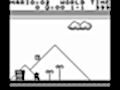
Mario & Luigi is an unofficial platform game created for MS-DOS by Dutch programmer Mike Wiering in 1994. Although closely modelled on Nintendo's Super Mario Bros. series, it is not a direct conversion of any existing Mario title and uses original level layouts created specifically for the PC.
Mario & Luigi (MS-DOS)
Wiering programmed the game in Turbo Pascal as an experiment in VGA graphics and smooth parallax scrolling, aiming to make the engine run well on his 25 MHz 486 computer. He originally intended to reuse the technology in later, more original games rather than release the Mario project commercially. The game follows the familiar structure of a side-scrolling Mario adventure. Players run and jump through the Mushroom Kingdom, collect coins and defeat enemies by landing on them or attacking them with fireballs. Mushrooms transform Mario into his larger form, while fire flowers grant a projectile attack that can be aimed horizontally or diagonally. Holding the run button allows longer jumps, an important technique for crossing some of the wider gaps. A two-player option is also included, with Mario and Luigi taking turns rather than appearing on screen simultaneously. The completed game contains six increasingly difficult levels featuring outdoor landscapes, underground passages, water hazards, moving platforms, pipes and castle-like environments. Unlike Nintendo's original games, it has no story sequences, background music or boss battles, and neither Bowser nor Princess Peach appears. The final stage ends with the words “THE END” formed from golden coins. Completing the game starts another, faster cycle in which movement and enemy behaviour become more demanding. An unusual part of the game's history concerns an unfinished four-level beta version that circulated without Wiering's approval. An unknown party modified it into a supposed shareware release, added documentation and a registration form requesting payment, and distributed it on disks and shareware CD-ROMs. Because its fourth level had never been completed, that version could not be finished and caused many players to search for a nonexistent exit. Wiering later released the authentic six-level edition for free, together with its complete Turbo Pascal source code and optional joystick support. While technically and visually modest, Mario & Luigi demonstrates accomplished DOS programming through its colourful VGA graphics, layered scrolling and compact size. Its controls can initially feel less fluid than those of Nintendo's console games, but the original stages provide a short and increasingly challenging platform adventure. The engine also became an important foundation for Wiering's subsequent work, eventually contributing to games such as Charlie the Duck and the more polished Mario-inspired platformer Super Angelo.
More details about this game can be found on MobyGames.com.
Find digital download of this game on GOG or Steam.
Game controls:
All DOS games were controlled directly from the PC keyboard. Some newer DOS games also used a mouse or other more advanced game peripherals for control. However, each game was controlled by different keys. You can find a detailed description of how to control this version of Mario and Luigi in the attached game manual. An overview of basic keyboard commands and keyboard shortcuts to control this game is summarized in the following table:
Keys
Action
← or →
Walk left or right
Ctrl + ← or →
Run left or right
↑
Climb up
↓
Climb down
Alt
Jump up
Space
Throw a fireball (works only after collecting the flower)
P
Pause
Esc
Game over (go to the Main Menu)
Platform:
This version of Mario and Luigi was designed for personal computers with operating system MS-DOS (Microsoft Disk Operating System), which was operating system developed by Microsoft in 1981. It was the most widely-used operating system in the first half of the 1990s. MS-DOS was supplied with most of the IBM computers that purchased a license from Microsoft. After 1995, it was pushed out by a graphically more advanced system - Windows and its development was ceased in 2000. At the time of its greatest fame, several thousand games designed specifically for computers with this system were created. Today, its development is no longer continue and for emulation the free DOSBox emulator is most often used. More information about MS-DOS operating system can be found here.
World Record:
The current world record for this version of Mario and Luigi is held by Pandora from Chile, achieved on 01/29/2020 with a result of 3m 29s (as recorded on Speedrun.com). However, for a result to be recognized as an official world record, it must be achieved on the original console without the use of emulators, and must be verified either by a video recording or in the presence of an official referee. So even if you break the record while playing here on our website, it unfortunately won’t be officially accepted. Still, we’d love it if you shared your performance with others in the discussion below – it counts too!
Available online emulators:
5 different online emulators are available for Mario and Luigi. These emulators differ not only in the technology they use to emulate old games, but also in support of various game controllers, multiplayer mode, mobile phone touchscreen, emulation speed, absence or presence of embedded ads and in many other parameters. For maximum gaming enjoyment, it's important to choose the right emulator, because on each PC and in different Internet browsers, the individual emulators behave differently. The basic features of each emulator available for this game Mario and Luigi are summarized in the following table:
If you like Mario and Luigi you'll probably like also some of the similar games in the overview below. The games you see here are selected based on title similarity, game genre, and keywords. However, the list is generated automatically and can therefore be very 'subjective' especially for some specific games. To find a particular game, please use our search form.
This website is NOT sponsored or endorsed by Nintendo, Atari, Sega or by any other video games company. dapplebrook.shop makes no claim to the intellectual property contained in the individual games. Text content of dapplebrook.shop is available under the Creative Commons 3.0 License. You can copy it freely, but indicate the origin and keep the license.


 This version of Mario and Luigi was designed for personal computers with operating system MS-DOS (Microsoft Disk Operating System), which was operating system developed by Microsoft in 1981. It was the most widely-used operating system in the first half of the 1990s. MS-DOS was supplied with most of the IBM computers that purchased a license from Microsoft. After 1995, it was pushed out by a graphically more advanced system - Windows and its development was ceased in 2000. At the time of its greatest fame, several thousand games designed specifically for computers with this system were created. Today, its development is no longer continue and for emulation the free DOSBox emulator is most often used. More information about MS-DOS operating system can be found